Friday, June 28, 2013

Immigration--Still On the Table--Sort Of

"I am the American heartbreak--
 Rock on which Freedom
Stumps its toe--
The great mistake
That Jamestown made long ago."
  ---Langston Hughes, "American Heartbreak"

This morning's newspaper declared in  a headline: "SENATE OKS IMMIGRATION BILL". The clinker is that now the Bill goes to the House of Representatives . The Republican leadership has already indicated that the bill will not get a vote in that chamber. The President has called the Senate's effort a historic step on one of the most important planks in his second-term agenda. Vice President Biden has called the vote a milestone.  Senator Marco Rubio has said he thinks it is critical to fix this broken system.

Well and good--because it gives 11 million immigrants some status so they don't fear being deported unless they commit a crime. But I have been wondering what kind of progress is this bill, really. It may never make it into law--the House of Representatives controlled by the Republicans may make sure this never happens. Unless--that is,  their leaders realize which way the wind is blowing and vote for the bill hoping to get some traction at the voting booth. Would you vote for somebody who obviously did not care for your well-being but desperately cared for your vote? Hmm.

One of my favorite plays is Inherit the Wind. One of the characters in that play says: "Bert, whenever you see something bright, shining, perfect-seeming--all gold, with purple spots--look behind the paint! And if it's a lie--show it up for what it really is!! We've got to look behind the paint on this issue. What do we find?


  • This bill allows the nation's unauthorized immigrants temporary legal status after they've passed a criminal background check, paid a fine (for what?) and paid whatever back taxes they may owe.
  • If they maintain a clean record and hold a job (if they can get one) they can then apply for a green card in ten years and U.S. citizenship three years later.
Senator Lindsay Graham, supporter of this bill says: "Then they can get at the back of the line and apply for citizenship in our country." As I read these words I remember another not back of the line but back of the bus that is a not-so-proud part of our history.

This bill means that if you keep your nose clean and jump through all our hoops you may just be able to apply for citizenship in thirteen years.

On this July 4th week-end I keep remembering our American poet wrote:

"Give me your tired, your poor,
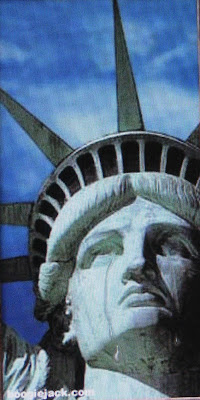
Your huddled masses yearning to breathe free, 
The wretched refuse of your teeming shore
Send these, the homeless, tempest-tossed to me,
I lift my lamp beside the golden  door."

            +              +              +

"Unless we are all free, we are none free."

            +               +              +

"We who are prosperous and independent have not 
sufficient homogeneity to champion on the ground
of a common creed, common stock, a common history, 
a common heritage of misfortune, 
the rights of the lowest and poorest Jew-peddler 
who flees, for life and liberty of thought, from Slavic mobs."


July 4th--Do You Have to be An American to Be a Christian?

"They were human, they suffered, wore long    black coat and gold watch chain. 
They stare from daguerreotype with severe reprehension,
Or from genuine oil, and you'd never guess any pain
In those merciless eyes that now remark our own time's sad declension."
--Robert Penn Warren, "Founding Fathers, Nineteenth-Century Style, Southeast U.S.A."


Recently a woman asked a man, “Are you a Christian?” He said, “Yes, I am an American.” A couple of years ago a student at the University of California raised her hand in the middle of a seminar the Professor was teaching on the first century of Rome and the dawn of the Christian era. She seemed genuinely disturbed. “I know you’re all going to think this is crazy, but I always thought Jesus was an American.” There seems to be a misunderstanding in many quarters of our country about the difference between faith and country.

You can be an American and be a Christian. You can be a Christian and be an American. But I am not at all sure that you can fuse the two categories. There is a line drawn between church and state.

Ever wonder why American and Christian are not synonymous? This national holiday weekend gives us a good opportunity to ask this question: What’s wrong with blending church and state? Jesus once said that we were to render unto Caesar the things that are Caesar’s and unto God the things that are God’s. We have obligations to Caesar and God but they are not the same loyalties.

Dissenters in England were forced to draw a hard line between Caesar and Christ. These dissenters were born at a time of great adversity. James I was the King of England. At that time England was fragmented into many religious factions. He solved the problem by forcing uniformity in all things religious. If they wanted to pray they were to use the prescribed prayer book. If they wanted to worship there was a set order to be followed. If they wanted to be a loyal member of the state then they would attend the Church of England. James I was followed by Charles I, who believed in the divine right of kings and bishops. In fact the words kings and bishops could be used interchangeably.

Many of those little groups who had grown accustomed to their own worship ways refused to conform to the edicts of the king. They were called: non-conformists. And they suffered such persecution that some of them moved to Holland. There John Smyth, one of their leaders would boldly write: “the magistrate is not by virtue of his office to meddle with religion, or matters of conscience, to force or compel men to this or that form of religion, or doctrine; but to leave Christian religion free, to every man’s conscience…for Christ only is the king, and lawgiver of the church and conscience.” Leonard Blusher wrote: “As kings and bishops cannot command the wind; so they cannot command faith.”

Needless to say this did not set well with the King or his religious minions. Many were driven out of town, some lost their lives, and others lost their income. So a group of them in search of religious freedom found their way to the new land called America. But already the Church of England in certain quarters of the new colonies already had a stronghold on religion in the new land. Dissenters were dragged into court, their homes and belongings were searched. Many were thrown into prison. In those early days in Massachusetts and Virginia and other colonies our history record oppression and persecution simply because people wanted to worship as they saw fit. And so slowly but firmly this phrase separation of church and state found its way into the Constitution of the new land. “Congress shall make no law respecting an establishment of religion or prohibiting the free exercise thereof...”Interestingly enough, many of those early dissenters championed freedom not only for themselves but they granted religious freedom to all persons.

What would those early champions of religious liberty say about judges, presidential candidates and other elected officials having to subscribe to some religious litmus test of someone else’s choosing? What would our forebears say to those who would propose the legislature in any state writing prayers to be used in public school classrooms? This is not the business of the state.

God never has been a taboo subject in this country. No group, including the Supreme Court can hound God out of any classroom. Someone asked President Harry Truman once about his faith. He barked back, “I am not a religious man. Mrs. Truman takes care of that.” But Mr. Truman was a person of faith. He grew up going to Sunday school, was grounded in Biblical knowledge and did some public praying while he was in office without fanfare. But he despised the idea that religion could be used for political purposes.

On this weekend when we think of our beginnings as a country—let us remember Jesus’ words to render unto Caesar the things that are Caesars but not the things that are God’s. The State can ask too much and that is why our forebears hammered out a new way that no other country had seen: to be an American does not necessarily mean to be a Christian. And to be a Christian you certainly do not have to be an American.


(This article appeared in The Greenville News (SC) Op Ed section, Sunday June 30, 2013)


Sunday, June 9, 2013

Father's Day Stirs My Memories

Father’s Day brings back memories to all of us. My own father worked hard in a cotton mill in Georgia for over 40 years. He was a Shift foreman much of that time. We lived in a mill house right across from the mill. Fatherhood must have been hard for him because he was almost deaf. He had a serious ear infection as a child and he lost his hearing early. So—he and I had a difficult time. I found it hard to talk to someone who could barely understand. He had a hard time hearing and responding. There was a great silence between us. Like most people with a severe hearing loss he kept to himself much of the time.

I don’t remember much of what we did together. We would take long walks in the woods on Sunday. That was about it. But on this Father’s Day I have a memory of my father that still shine after all these years. I heard Billy Graham who was just becoming famous, was holding a crusade in Atlanta. I wanted to go bad. But I had never been to Atlanta. We did not have a car and I thought that this was just a dream. Not so. My father found out that the crusade would begin October 29. The year was 1950. I was a sophomore in High School. He told me we were going to hear Billy Graham in Atlanta. We were going to ride a train which would be the first for me. So early Sunday morning we took the city bus down to the Train station. A friend, Bob met us there. The three of us boarded the Hummingbird and away we went.

The excitement of the train ride must have been as exciting as the trip to Atlanta. Finally the train stopped and we found out where we could take a bus to Ponce de Leon Park where the Atlanta Crackers played baseball. We ate hot dogs in the parking lot and found our way inside. There were 35,000 people there. I remember where we sat—way back where you could hardly see but we were there. And I don’t remember the sermon but I do remember the day. After the service ended, we took another bus back down to the Atlanta train station, boarded our train and came home.

It might not seem like much—but that trip was a momentous time in my life and the life of my friend. We both found ourselves years later in the ministry and serving churches. But the point is: My Daddy tired though he was on the weekends after working six hard days in the mill he arranged that trip to please his boy. He made little money and those train tickets even back then must have been a sacrifice.


And so on this day when fathers good and bad are remembered—I look back on a bus trip to the train station and my first train ride to Atlanta. I remember hearing Billy Graham. But what I remember most of all was that it never would have happened without my father. And this is what I remember more than anything this Sunday morning. 

Wednesday, June 5, 2013

Will Campbell--a Real Live Baptist

As so many so-called Baptists are getting on the bandwagon to deny gay scouts from that organization--I learned of Will Campbell's death.

Preacher Will--a Baptist preacher--colored outside every line. He was ordained in Mississippi with a Bible the KKK had given to his church. But he caught a larger vision which took everybody in.

He loved hard, living people--but he really loved everybody. He walked with the little children trying to integrate schools in Little Rock. He was a friend of many of the Civil Rights' leaders. John McCain couldn't hold a candle to this maverick. He visited James Earl Ray in jail. He went on the road with Waylon Jennings and other country music folk and was their Chaplain. He knew them all: Johnny Cash, Willie Nelson, Dick Gregory, Jules Feiffer and Studs Terkel just to name a few. He baptized some of them, counseled them and had their weddings and their funerals. Despite his commitment to civil rights--he believed that old idea that in the South that all poor people had been discriminated against--whites and blacks. So he was friends with leaders in the KKK. He spoke out against war and poverty and had little use for the institutional church. He reached his arms around all the alienated.

Yet he believed deeply in the Bible and its inclusiveness. Not some inclusiveness--but for everyone. He wrote books that warmed many a heart. His book,  Brother To a Dragonfly told the story of his Pharmacist-brother's struggle with drug addiction. In one of his books he says that one of his sorrows was that "there weren't any Baptists anymore." Well--there was at least one. His name was Will. He gave hope to a multitude of Baptist preachers in particular that were trying to be faithful in a difficult time.

This morning I was reading in the book of Exodus when there are instructions of how to build and furnish the tabernacle. I was struck with passages in Exodus 25 and 26. The centerpiece of the worship center was to be "the mercy seat." The Mercy seat sat atop the Ark of the Covenant which was kept in the Holy of Holies first in the Tabernacle and later in the Temple. The Mercy Seat was sometimes called the throne or the footstool of God on earth. Animals were sacrificed there for the sins of the people and any uncleanness that defiled the sanctuary. The word mercy seat meant to cover or to wipe clean.

What happened to the church? Not just Baptists but just about every group that claims the name of Jesus. The heart of it all is to be a place of mercy. Will Campbell kept trying to keep the Mercy Seat front and center. His message offended almost all of us from time to time. But deep in our hearts on our better days we know that pure kindly light is not just for some but for all. Will Campbell knew about mercy...and we still need to listen closely to his message.

(You might be interested in Bill Leonard's splendid piece on Will Campbell--it's great.)


(The statue at the beginning of this article can be found at Five Points in Birmingham (AL.) Brother Bryan was a Presbyterian preacher who loved everyone and gave his life to the people of the city. Rich, poor--it did not matter. After his death the people of Birmingham had this beautiful rendering of Brother Bryan and placed it at the cross-roads in downtown Birmingham. 

The Golden Cross hangs in the St. Aloysius Catholic Church in Oxford England. Gerald Manley Hopkins was Curate in this church for a year.)

Tuesday, June 4, 2013

Boy Scouts and Gays

"What is it about the word All that we don't understand?"


I didn’t know there were boys that could not join our Cub Scout or Boy Scout troop. This was the forties we were all lily white and there were few black boys to be seen. I never wondered back then where were the black boys my age. They didn’t go to school or church with us—so why would I have wondered. I never thought back then what it must feel like to stand on the other side of the plate glass window and peer in at what one could not do. Segregation was a terrible thing and we are still having to live with its residue. Years later when I was too old to be a Scout the color line came down and black boys could discover the joys and fun of being a scout.

And so when I read that the National organization of the Boy Scouts of America was in the process of dismantling another wall I was very proud of the Scouting movement. Gay boys could now join the Scouts  as if they were “just like us.” Of course there have always been gay scouts but they knew their place: they stayed in the closet. We were also unaware of the sexual abuse by Scout leaders which has only recently bubbled to an embarrassing surface.This whole sad chapter in scouting was kept under wraps until recently. One wonders just how much damage and destruction that was done through the years by these particular Scout leaders and the resounding silence of the organization..

What the national scouting officials have done is to put homosexuality on the table. They join much of society that has come to know that to be gay is first to be a human being with dreams and goals like the rest of the human family. There are walls enough for all of young people without adding segregating gay young men to the list of our prejudices.

The confusion has come with all those that link homosexuality with promiscuity. They say homosexuals are sinners. They say this lifestyle is wrong. They say these people are different from the rest of us. Consequently, many churches are distancing themselves from the Scouting movement. Prominent Southern Baptist Pastor, Rev. Ernest Easley of Marietta, Georgia has already led his church to cut ties with the scouts over this new policy. The large South East Christian Church in Louisville has announced plans to shut down its troop. Dr. Richard Land, Southern Baptist leader has said, “Frankly, I can’t imagine a Southern Baptist pastor who would continue to allow his church to sponsor a Boy Scout troop under these new rules.” On the flip side President Obama and Mitt Romney both have called for an end to a ban on gay scouts. Mormons and United Methodists have indicated that they would not obstruct the new policy.  One official of the United Church of Christ has said, “Cutting ties with the Boy Scouts makes no sense...because it tells gay Scouts they should be shunned.” He went on to say that such a stand sends a terrible message to youth of any sexual orientation. When we declare someone different from the crowd—they can be seen as subhuman or perverted and despised. 

We seldom link rape or incest or sexual promiscuity to the term heterosexual. We know better. These perpetrators do not represent heterosexuals. For heterosexuality is not simply about sex but the prism through which one looks at all of life.

Cannot we say the same thing about homosexuality. The perverted or the disturbed are exceptions to the rule. Take Pascal Tessier is a young 16-year-old gay scout from Kensington, Maryland. He feared that his scouting career would be cut short by the ban. Now he will be able to finish his work towards Eagle Scout, which is the highest rank in Scouting. Mr. Tessier said, “Sexuality doesn’t have any place in scouting—so why put it there?” Are we as a society going to continue to make progress until the word, all really does include everyone? Segregation in any form is wrong and detrimental to the human condition.Churches that turn their backs on gay youth are sending a powerful message. Perhaps the old Gospel song, "Whosoever will may come..." should add another phrase: with qualifications. 

I still remember the Scout oath I took years ago:

On my honor, I will do my best
To do my duty to God and my country and to obey the Scout law;
To help other people at all times;
To keep myself physically strong, mentally awake and morally straight.


What does this mean? Scouting is not just about white boys or straight boys—but just boys with no accompanying labels. They are hopefully trying to discover their real identity as human beings and reach up and claim the full promise of who they are. Gay, straight or any other of our labels—we are all children of God. Churches of all groups should reach out its arms as wide as were the Savior's.


Sunday, May 26, 2013

Memorial Day--It's Touching Time

As this Memorial Day approaches I remember a powerful scene that expresses what I feel about this day. It comes from a book by the Kentucky writer, Bobbie Ann Mason. The book is called In Country and told a Memorial Day story in very human terms. The central figure in the story was Sam who lived in this tiny town in western Kentucky. Sam was conceived while her Daddy was home on leave but died in Vietnam before Sam was born. All her life she heard stories about her Daddy, Dwayne and tales about the in Southeast Asia. Emmett, a good friend of the family was also in that war and kept telling Sam about her Daddy and what a hard time it was. He told about many soldiers he knew who never came home. He also told her about all the Vietnam veterans who were on the streets or were crippled in mind or body. Sam took it all in and kept fantasizing about a Daddy she wished she had known.

Emmett decided one day that it would be a good thing to take Sam and her grandmother, Mamaw to see the Vietnam Memorial. He wanted them to see her father’s name on the monument.  So one morning they got in Sam’s old car and drove to Washington. It took a long time. Mamaw brought a geranium to leave at the Memorial.  Finally they got to Washington, fought the traffic, and found the sign which read: Viet Nam Veterans Memorial and an arrow pointing the way. Parking was a real problem but they found a spot on a side street. They got out of the car and helped Mamaw up the path to see the Memorial.

And there it was. A black slab that just looked like it emerged from the ground. It was massive and held the names of the 58,000 men and women who had died in Vietnam.  That huge black slab was nothing like they thought. Name after name really told the story of those that had died in the war. People were everywhere. All ages. Some were kneeling and touching the Wall. Some brought notes and flowers. An old vet dressed in army fatigues held his hand over his mouth as he scanned the names. A woman wiped her face with a handkerchief.

Emmett, Sam and Mamaw found the directory that told where all the names were. They finally found Dwayne’s name and the direction to where his name was. They found the section where the name was to be but there were so many names. They keep looking and way up high they saw the name: Dwayne E. Hughes. They just stood there looking up. Emmett took the Geranium from MaMaw and knelt down and placed it at the base of the granite panel. Mamaw said, “Oh, I wish I could touch it.” So Sam rescued a ladder from some workmen nearby, opened it. Slowly they helped Mamaw up rung after rung. She found the name of her grandson. Ever so slowly she reached up and touches his name. The old woman ran her hand over his name etched in granite. She didn’t say a word. After a long time she said, “Hep me down.”

Then it was Sam’s turn. She climbed up and touched the name of the Daddy she never knew. When she backed down the ladder Mamaw clutched her arm and said, “Coming up on this wall of a sudden and seeing how black it was, it was so awful, but then I came down in it and saw that white carnation blooming out of that crack and it gave me hope. It made me know he’s watching over us.”


This ought to be a day for memories. Remembering all those that have died for us and for this country. Remembering all the brave soldiers of all the professions who have worked and dreamed and labored and lived and loved. We would be different people were it not for some soldier, some teacher, some Mamaw—some person whose name is not inscribed on anybody’s wall—but it etched on the wall of our hearts. None of them died in vain. Take a few moments and remember all the fallen. It is touching time—running our memories over the names and the faces of all those who have made a difference in our lives.


Thursday, May 23, 2013

Oklahoma Tornado--Why?

"O God, Creator and good keeper of the world and author of human freedom, give us the courage necessary to live and to minister in the midst of so much suffering. Give us the maturity to manage our own lives and not to curse you in the midst of distress. Above all, O God, give us that keen awareness of your intimate presence with us, so that we can respond to joy or suffering, to good and to evil, in ways that glorify you, and write new chapters in the history of salvation. In the name of him whose title is Emmanuel, God with us,Amen."
           --W. Sibley Towner


For days now I have sat like many of you before the TV with my hand over my mouth. What can we possibly say to those 56,000 in Moore, Oklahoma? So many of their children dead, so many of their neighbors in hospitals. So many who stagger through the debris trying to pick up the pieces of their lives. Like Newtown at Christmas and Joplin, Missouri in 2011 and all the other crises—we now weep for our brothers and sisters in Oklahoma.  Once again the settledness of life has been torn up by its roots. And the stories just keep coming. A woman sorting through her wreckage looking for photographs of a Mother that died in 1947. The couple standing with a handful of splinters saying, “This is all that is left of our house.” The courage of those teachers who lay on top of their kids or huddled with them in closets to keep them safe. The farm that lost over 100 horses on Monday afternoon. All these and so many more are trying to find something familiar to hang on to when all they have known has been swept away. Over and over we ask why. Why? Job is the oldest book in the Bible and its theme deals with this question. When that long book is finished, most of the whys are left unanswered.  

What are we to do with the whys? Why Moore, Oklahoma? Have they suffered enough—this is their time around. Survivors say they are safe because their prayers were answered. Did those that did not make it pray? Hmm. Job's friends with reasons why Job was in such a mess. His sins must have been monstrous to have lost his family, his home, his health—everything. With friends like this who needs enemies. The finger pointing of retribution is one way of dealing with suffering. We have our blamers, too. From the safety of some air-conditioned room they preach judgment toward whatever groups they despise this week. God, they say, is trying to teach us a lesson that would force us to change our ways.* You don’t hear those sorting through the wreckage saying such words. They are much too busy trying to put their lives back together. Why would God punish these thousands of folk for the sins of some and leave the rest of us safe? Are we less sinful?  What kind of a monstrous God would this be? 

Standing before this river of pain some respond by saying we can do nothing but wring our hands in despair. The world, they say, is an unfriendly place. It is marked by fissures and potholes. If we live long enough, they tell us, surely the darkness will come to us all. This hand wringing is reflected in much of popular culture. Our films and books are filled with stories of a world entrenched with evil. Is life only a windowless room with no exit? Most of us have felt this hopelessness from time to time. Is our best response to suffering simply to wring our hands and shake our heads? 

There are is another reply to these whys. It is a faith response. We can turn our hands upward.  When a child died suddenly the mother asked her preacher, “Where was God when my child died?” The minister said quietly, “The same place God was when his son died.” In times of great pain we can reach upward. We can cry out to God. One third of all the Psalms in the Bible are Psalms of Lamentation. God’s people railed out their questions, their pain, and sometimes their rage to their God. Again and again they came back feeling they were heard and cared for. This is not a picture of a vengeful God but a God who hears and cares. We are not alone. The pray-ers and the non-prayers—the survivors and the dead—God is with us all.  

An outgrowth of such faith is do something positive. We can turn toward those in need. This is at the heart of the Judeo-Christian faith. We can care for those who have suffered terrible losses. We can send clothing and food to those left homeless. We can get out chain saws and cut away trees and bramble. We can give to worthy organizations. We can volunteer by spending time helping those whose names we do not know. We can badger state and national leaders until they respond as our government should. Isn’t this the real task of government—to care for its citizens? And we can make sure that after the headlines are over and the hard work of rebuilding is still to be done, we do not forget those in need. We learn again that the word neighbor transcends every barrier. We do what we can.  

Our actions will not undo the damage or bring back the dead. Life will be forever different for those touched by the events of this hurricane. The people of England found this to be true during the Second World War. Bombs fell on London for over 60 days. Much of that country was destroyed. Thousands were killed and survivors were left homeless.  Great gashes and craters were left where the bombs had fallen.  But the next spring those same craters were covered in flowers. Botanists reported that the bombs and their nitrates had unearthed bulbs, some hundreds of years old. Those flowers covered over much of what the damage had brought. 

What are we to do with our whys? We can point fingers or wring our hands. Or we can reach out in faith and do what needs to be done. Bertholt Brecht, the poet asks, “In the dark times will there also be singing?” That’s what we hope for those in Moore, Oklahoma and for us all.


*Michelle Bachmann speaking in Florida spoke of her understanding of what was happening in different places in the country: "I don't know how much God has to do to get the attention of politicians. We've had an earthquake; we've had a hurricane. He said, 'Are you going  to start listening to me here?' Listen to the American people because the American people are roaring right now. They know government is on a morbid obesity diet and we've got to rein in the spending."